On the day I was born, the only thing orbiting the Earth was the moon. By the time I was 5, however, the two most advanced nation-states had gotten men into orbit. This culminated, when I was twelve, in a manned moon landing. I recall very clearly how the entire world seemed to stop and take a collective breath as terrible, grainy TV pictures and prosaic radio traffic chronicled mankind's greatest technical achievement.
Fifty years on, only one more nation has launched men into orbit, and a coalition of european nations can send hardware into deep space. But the United States no longer launches men and women into orbit. We retired the Shuttle fleet after demonstrating that this task, while risky and expensive, could be performed routinely.
NASA has lost its way, some people say. America has lost its will, some people say. Another symbol of decline, say some.
I don't think so.
An American company called SpaceX, with only 1,100 employees, has learned to reliably launch payloads to orbit. Manned launches are close, held back mostly by concerns that their safety be more thoroughly demonstrated. A couple of other companies are close. Their cost per kilo to orbit is a fraction of that charged by the defense giants who assemble rockets for governments.
This result is astonishing. It means, here in the U.S. at least, we don't need the government to fund commercial activities in space. They fund themselves. It is a triumph of capitalism, almost unheralded. What it means is, the United States wasn't sitting on its hands for the last fifty years. We were investing in materials science, electronics, software, and all the things that actually make up a space mission. We were making launch capability reliable enough that companies would risk nine-digit bankrolls on activities in space. In the language of business, we built a reliable supply chain to space. This was something NASA knew we needed to do way back in 1980.
And where is NASA? Right where they should be, reaching out for another planet that we cannot yet grasp. Probably all other planets by the time we put boots on Mars. This year (2014), there isn't one part of a Mars mission that we really know how to do; keeping human beings healthy and strong on a long voyage; soft-landing a big payload on Mars; building a rocket on-site for the return to Earth. Some of these problems can be solved by brute force and expenditure of treasure. That's what NASA is for. And right behind are the entrepeneurs and their engineering teams, looking to finesse these problems to make it economical.
To those who say we should forget about space and spend NASA's budget to end poverty and hunger, I have this to say. Poverty exists by definition. It can't be eradicated in a society that rewards achievement. And NASA's budget could not banish hunger from the world for as much as a single day, especially where and when evil men wield hunger as a political weapon. President Kennedy had it just right when he said we do things like exploring space, "not because they are easy, but because they are hard." Mankind needs something to strive against, in order to make progress. What Kennedy didn't mention was that the problem of going to Mars is actually more tractable than the problem of ending hunger.
And to those who say manned exploration is frivolously expensive when robots can do it better, I say this. Who cares if there is an ocean on Titan if we will never stand on its shore? Why return pictures of Mars' dusty, cobbled plains if we will never walk them? Expanding mankind's reach is the only reason to visit space. We should only use robots where we cannot yet venture.
Mankind's conquest of orbit is nearly complete. The geeky
men and women who will design, build, and fly the first manned Mars
mission are in high school right now. They grew up in a world where
manned space launches were so routine they only made the news by being
so dramatically photogenic.
I expect to watch the Mars landing in beautiful hi-def color before I die of old age. Maybe on my wall-sized flat screen, maybe on my wristwatch. The men who landed on the moon were my father's age. The men and women who land on Mars will be my childrens' age.
So stop wasting time reading this and get to work!
Showing posts with label life. Show all posts
Showing posts with label life. Show all posts
Friday, December 26, 2014

Thursday, March 6, 2014
Things Only Taught by Time
What do you learn over a career of coding, besides 123 different APIs? What's all this value in being an Old Hand? Well...
- When I was interviewing for work, right out of college, there was a job I didn't take because all the developers had foot-thick listings on top of their filing cabinets. I knew my modest brain could never comprehend such a massive amount of code. Ten years later, I delayed learning Windows programming because applications appeared indecipherably complex, with dlls and a configuration database instead of a single executable.
I don't print paper listings any longer, but if I did, mine would be ten feet tall. I've built many Windows apps. It sucks to manage dlls, but not because they're too complex to comprehend.
LESSON: Anything that other programmers are comfortable with is not too complex for you.
- I spent 10 years becoming a deep domain expert at my first company out of college. I figured I would become a "lifer", safe from the travails of the job market because of my valuable knowledge. Then during an economic downturn, the company changed strategic direction. They shuttered my whole division, laying me off along with 19 of 21 engineers, 12 of 12 marketing folks, and about 50 factory workers.
It was hard finding a new job because (1) it was the bottom of a recession, (2) my deep domain knowledge was not applicable at any other employer in the city, and (3) I had neglected to learn the latest programming skills because I didn't believe, as a lifer, that I would need them to be up-to-date.
LESSON: Skills and experience are only valuable if they help you find work.
LESSON: Skills and experience that help you find work are valuable.
- The two engineers that my one-time lifetime employer retained? One was a very lucky new college hire. The company valued its reputation for firm job offers. The other survivor was a nice lady; very quiet, someone who never asked questions or made requests. She wasn't the smartest engineer. She wasn't the most innovative. But she turned out an utterly reliable so-many-lines of code each month without variation. She became a lifer at that company.
LESSON: what managers value in a software developer is not intelligence, or innovation, or great code. They value reliably low maintenance workers.
- My very favorite sister-in-law died of cancer at 39 years of age. When her cancer was diagnosed, she didn't quit her job right away, but she did change her behavior. All of a sudden there were some meetings and some tasks that seemed so unnecessary that they offended her sense of limited remaining time. She told me that a week before her diagnosis, she had wasted a bunch of time in these meetings, and all of a sudden she really wanted that time back. She began focusing exclusively on the parts of her job that added value and that gave her satisfaction. She put off the dumb stuff as long as she could. She discovered that lots of dumb stuff eventually just went away if she put it off, because it was dumb stuff. She didn't lose touch by skipping boring meetings. They were boring because nothing happened in them. In this way she became recognized by her managers as the most productive worker in her office.
I was going to boring meetings where nothing happened too. I vowed to behave as though I had six months to live. I became more productive, because I only did activities that added real value, and that I enjoyed. I came to feel as though I had become bulletproof. I reasoned that if I was ever let go for only doing productive work, the company would be doing me a tremendous favor. Such a company would not last long, and working there until the end would be awful.
LESSON: Only do tasks that add value. You will be the most productive member of your team.
- I became unemployed in the dot.com crash, becaue my dot.com employer collapsed. It was hard to find work because it was the dot.com crash, and nobody was hiring. It wasn't that I had the wrong skills or wanted too much money. There just wasn't anyplace to send a resume. It turned out that I wasn't bulletproof after all. I went from being the most employable guy I knew to being chronically unemployed. I became unemployed again in the Great Recession. Two employers in a row suffered dramatic, thirty per-cent revenue declines, and laid off their whole software team.
LESSON: Bulletproof is not the same as invulnerable. Pride goeth before a fall.
LESSON: Most software development work is project-oriented. Your job is always vulnerable between projects.
LESSON: It is always the bottom of a recession when you get laid off. Nobody will be starting new projects then. It is prudent to have money in the bank to last you a year or so.
Thursday, August 9, 2012
2,000 Mondays
This post is a warning to undergrad CS majors. The stories you hear about the "real world" are not the truth.
There's this place called Xerox PARC. At the dawn of the Computer Age they invented personal computers, and Ethernet, and Smalltalk, and windows and stuff. And the conference rooms were full of beanbag chairs and the streets were paved with gold. This is what your professors think the real world looks like.
There's this cool startup you'll hear about (a different one each year), where they give you a MacBook to develop on, and there is free pop and snacks in the fridge, and wine on Fridays, and the office is decorated in twenty-something chic, with a universal gym and foosball tables, and you can work any hours you want, and dress like a slob.
This is the "real world" you hear about in college. It's a world where nerds rule and employers are so desparate for top talent that they'll do anything to keep you happy.
It's a fantasy; a fairy tale told by people (students) who have never even seen the real world, and people (professors) who turned their backs on the real world in favor of a place where you could never ever ever be fired no matter how you behaved, once you got tenure.
Mostly, the real world looks like this.
The real world is a very interesting place. There are lots of challenging, engaging projects in the real world. But it's not a playground. Most offices are cube farms or open bullpens. There are a whole lot of add/change/delete screens
and login pages to code for each unique and challenging algorithm you get to invent. There are a thousand lines of somebody else's poorly written code to patch for every line of your own unique software stylings.
Employers really are desparate for top talent. Only the thing is, new grads aren't top talent, no matter how smart you are. You're a n00b, a novice. You won't even know how much you don't know for a couple of years. To employers, top talent means that one guy on the team who turns out 10 times as many lines of solid, functioning code as anyone else; who works 80 hour weeks for 40 hours of pay; who's been coding since he built his first computer from individual logic gates when he was six. Top talent has already worked for Microsoft and Google and Facebook. That's how your employer knows they're top talent. You haven't worked for anyone at all.
There are indeed startups with free food, and wine, and foosball, and a fancy office. They just aren't all the same startup. And most of them are in just one or two cities; cities where a decent house costs a million bucks; cities you don't currently live in. What every startup has is long hours and low wages and stock options, which 99 times out of 100 expire worthless, and 1 percent of the time make you a millionaire. Most startups only live for a year. Then they crash and take your dreams of wealth with them, leaving you unemployed, wondering why you worked so hard for so little.
In the real world, if you're lucky, you either play nice with others, or find yourself suddenly unemployed. If you aren't so lucky, your employer doesn't care if you smell like sweat socks and annoy your colleagues with conspiracy theories, because basically they don't even care if you are a carbon-based life form, as long as you crank out code.This type of employer treats you like a replaceable part, and discards you like last years' cell phone when they're done with you.
In the real world, your CEO is probably not a geek. He's probably an extraverted, glad-handing, back-slapping, ex-frat-rat, because weirdly enough that's the right skill set for a CEO. He definitely votes Republican. And he thinks you look a lot like the nerdy kids he used to stuff into lockers and trip in the cafeteria.
Working in the real world is a job. It can be a lot of fun, but it's also a lot of work, and a certain amount of tedium, and a certain amount of putting up with stuff you don't like. There are 2,000 Mondays in the average career. Anyone who tells you different doesn't know what he's talking about.
There's this place called Xerox PARC. At the dawn of the Computer Age they invented personal computers, and Ethernet, and Smalltalk, and windows and stuff. And the conference rooms were full of beanbag chairs and the streets were paved with gold. This is what your professors think the real world looks like.
 |
| Xerox PARC, ca. 1980: A fantasy of the real world |
This is the "real world" you hear about in college. It's a world where nerds rule and employers are so desparate for top talent that they'll do anything to keep you happy.
It's a fantasy; a fairy tale told by people (students) who have never even seen the real world, and people (professors) who turned their backs on the real world in favor of a place where you could never ever ever be fired no matter how you behaved, once you got tenure.
Mostly, the real world looks like this.
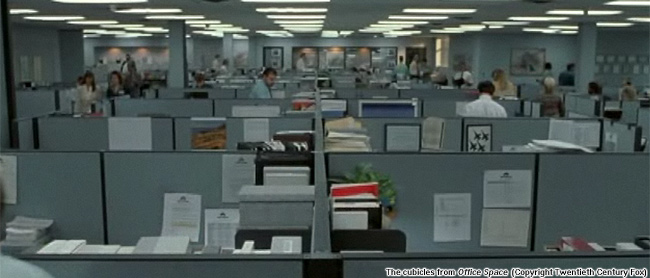 |
| Sorry, this is a lot more real |
Employers really are desparate for top talent. Only the thing is, new grads aren't top talent, no matter how smart you are. You're a n00b, a novice. You won't even know how much you don't know for a couple of years. To employers, top talent means that one guy on the team who turns out 10 times as many lines of solid, functioning code as anyone else; who works 80 hour weeks for 40 hours of pay; who's been coding since he built his first computer from individual logic gates when he was six. Top talent has already worked for Microsoft and Google and Facebook. That's how your employer knows they're top talent. You haven't worked for anyone at all.
There are indeed startups with free food, and wine, and foosball, and a fancy office. They just aren't all the same startup. And most of them are in just one or two cities; cities where a decent house costs a million bucks; cities you don't currently live in. What every startup has is long hours and low wages and stock options, which 99 times out of 100 expire worthless, and 1 percent of the time make you a millionaire. Most startups only live for a year. Then they crash and take your dreams of wealth with them, leaving you unemployed, wondering why you worked so hard for so little.
In the real world, if you're lucky, you either play nice with others, or find yourself suddenly unemployed. If you aren't so lucky, your employer doesn't care if you smell like sweat socks and annoy your colleagues with conspiracy theories, because basically they don't even care if you are a carbon-based life form, as long as you crank out code.This type of employer treats you like a replaceable part, and discards you like last years' cell phone when they're done with you.
In the real world, your CEO is probably not a geek. He's probably an extraverted, glad-handing, back-slapping, ex-frat-rat, because weirdly enough that's the right skill set for a CEO. He definitely votes Republican. And he thinks you look a lot like the nerdy kids he used to stuff into lockers and trip in the cafeteria.
Working in the real world is a job. It can be a lot of fun, but it's also a lot of work, and a certain amount of tedium, and a certain amount of putting up with stuff you don't like. There are 2,000 Mondays in the average career. Anyone who tells you different doesn't know what he's talking about.
Sunday, August 5, 2012
How I Became an Old Hand
One morning, about 17 years into my career, as I sat down in front of my terminal to begin a day's coding, a thought occurred to me. I knew, with the certainty of muscle memory, that any idea I could think up, I could turn into working code. What was more important, I realized that this hadn't been true a year ago. There were things I wouldn't have dared attempt because they seemed to me too hard or ill-defined.
Seventeen years is a long time to master a craft. I'm sure there are people who became master craftsmen in fewer years. I'm also sure that anyone who thinks they have mastered software development in one year, or in five, is delusional. Mastering the craft of software development is like mastering a martial art, sport, or musical instrument. There are aspects of the craft that just take time to develop. There are no shortcuts.
You are an Old Hand when you know you are one, with the certainty of completely internalized reflexes. There is no test. There is no certification. There is no course of study. You cannot buy mastery with any currency but time and practice.
That does not mean you cannot improve. Mastery is only obtained through study, but study doesn't lead to mastery. Study does lead to knowledge, and to improved practice. But mastery comes from a different well.
Mastery doesn't mean you cannot improve either. With considerably more years practice behind me, I find coding tasks come easier and easier. And I'm still learning too.
Seventeen years is a long time to master a craft. I'm sure there are people who became master craftsmen in fewer years. I'm also sure that anyone who thinks they have mastered software development in one year, or in five, is delusional. Mastering the craft of software development is like mastering a martial art, sport, or musical instrument. There are aspects of the craft that just take time to develop. There are no shortcuts.
You are an Old Hand when you know you are one, with the certainty of completely internalized reflexes. There is no test. There is no certification. There is no course of study. You cannot buy mastery with any currency but time and practice.
That does not mean you cannot improve. Mastery is only obtained through study, but study doesn't lead to mastery. Study does lead to knowledge, and to improved practice. But mastery comes from a different well.
Mastery doesn't mean you cannot improve either. With considerably more years practice behind me, I find coding tasks come easier and easier. And I'm still learning too.
Wednesday, August 3, 2011
Why I Took Computer Science
I went to college to get educated, back when people thought they could be successful even if they didn't go to college. (Taking manufacturing jobs. Wonder how that worked out for them?) I took this two credit class called Math 111A, which featured programming the pdp-8, and CDC Cyber 6600. And programming the pdp-8 emulator on the CDC 6600.
Of course this course was taught by a grad student. And it was arguably the worst instruction I received in college. Someone asked how to name variables. The teacher said, "Name them anything you like. Call them Kirk, Spock, and McCoy." So my first program had variables called Kirk, Spock, and McCoy. I didn't understand the difference between symbolic constants that named memory locations (variables) and symbolic constants that named constant values. It was amazing I ever got my programs to run.
There was an actual pdp-8, a filing-cabinet-sized microcomputer with almost 8,000 gates(!) and actual magnetic core memory. You fed it programs using the paper tape reader on an ASR-33 Teletype. First you toggled in a simple loader on the front panel switches. Then you used that loader to load the RIM loader off paper tape. Then you used the RIM loader to load your program. The machine was so mechanically flakey that it was even money it would stay up this long.
On the strength of this vast experience, I applied for a programming job, which ended up making me spending money the rest of the way through school.
My college GPA intersected with the Department of Computer Science's requirements during exactly one academic quarter, which coincidentally turned out to be the quarter I applied. After that the decision seemed to have been made.
The summer between my Junior and Senior year was The Energy Crisis; the first time energy stopped being ridiculously cheap and infinitely available. Campus authorities went around turning off the A/C to all the buildings on campus. The only exception was the Hospital. And the Academic Computer Center. Seems the mainframes like it cool. This cemented my already firm intention to go into software.
After school, I took my first full-time software job at Fluke in Everett WA. Of course by then I had a lot invested in being a software engineer, but there were two more events that confirmed my decision. I watched a summer EE intern destroy an irreplaceable prototype display tube. He powered it up. There was too much current in one column driver, and the column wire burned up, making this sad little "tink" noise as it died. This increased the current in all the other columns. You could hear it die, "Tink. Tink. Tink, tink, tink, tink-tink-tink-tink-tink." It was totally not his fault. The driver chips for this display weren't available yet, and we were were overdriving chips for a lower voltage display. But he felt so bad. I liked the notion (not completely correct) that when software crashes all you lose is time.
I had an EE colleague at Fluke named Jim Lenker. Jim was a thrill-seeker. He drove too fast. He went scuba-diving alone. He was missing a finger on one hand that he had cut off in an accident. But I noticed that when he worked with high-voltage circuits, he put his left hand in his back pocket to prevent making a circuit across his heart. Computers were all 5 Volts at the time. You can scarcely feel 5 Volts on your tongue. I liked that.
Of course this course was taught by a grad student. And it was arguably the worst instruction I received in college. Someone asked how to name variables. The teacher said, "Name them anything you like. Call them Kirk, Spock, and McCoy." So my first program had variables called Kirk, Spock, and McCoy. I didn't understand the difference between symbolic constants that named memory locations (variables) and symbolic constants that named constant values. It was amazing I ever got my programs to run.
There was an actual pdp-8, a filing-cabinet-sized microcomputer with almost 8,000 gates(!) and actual magnetic core memory. You fed it programs using the paper tape reader on an ASR-33 Teletype. First you toggled in a simple loader on the front panel switches. Then you used that loader to load the RIM loader off paper tape. Then you used the RIM loader to load your program. The machine was so mechanically flakey that it was even money it would stay up this long.
On the strength of this vast experience, I applied for a programming job, which ended up making me spending money the rest of the way through school.
My college GPA intersected with the Department of Computer Science's requirements during exactly one academic quarter, which coincidentally turned out to be the quarter I applied. After that the decision seemed to have been made.
The summer between my Junior and Senior year was The Energy Crisis; the first time energy stopped being ridiculously cheap and infinitely available. Campus authorities went around turning off the A/C to all the buildings on campus. The only exception was the Hospital. And the Academic Computer Center. Seems the mainframes like it cool. This cemented my already firm intention to go into software.
After school, I took my first full-time software job at Fluke in Everett WA. Of course by then I had a lot invested in being a software engineer, but there were two more events that confirmed my decision. I watched a summer EE intern destroy an irreplaceable prototype display tube. He powered it up. There was too much current in one column driver, and the column wire burned up, making this sad little "tink" noise as it died. This increased the current in all the other columns. You could hear it die, "Tink. Tink. Tink, tink, tink, tink-tink-tink-tink-tink." It was totally not his fault. The driver chips for this display weren't available yet, and we were were overdriving chips for a lower voltage display. But he felt so bad. I liked the notion (not completely correct) that when software crashes all you lose is time.
I had an EE colleague at Fluke named Jim Lenker. Jim was a thrill-seeker. He drove too fast. He went scuba-diving alone. He was missing a finger on one hand that he had cut off in an accident. But I noticed that when he worked with high-voltage circuits, he put his left hand in his back pocket to prevent making a circuit across his heart. Computers were all 5 Volts at the time. You can scarcely feel 5 Volts on your tongue. I liked that.
Why I Went to College
This is the story I always tell when somebody asks me why I went to college. One reason the story is interesting is that it isn't even my story. It belongs to my wife's brother Dan, who is a construction welder. Here's the story.
A ditch box is two steel plates held about 3 feet apart by braces. You put a ditch box in the ground when you have to work in a ditch because ditches tend to collapse in wet weather, and this is Seattle we're talking about.Of course that isn't really why I went to college. Well, it kinda is. I went to college because I wasn't really a grownup when I was 18 and it was go to college and get to live comfortably at home, or go to work and live on my own. Besides, there was just this background assumption in my family that everybody would go to college. But it was clear in my mind that I would rather work indoors in an air-conditioned office, and sitting down if I liked. And I would be happiest if the most dangerous thing I did on a daily basis was drive to work. And that's why I went to college.
So, my brother-in-law Dan is working outdoors, six feet below grade, in a ditch. It's the fifteenth of December. It't 35 degrees F and drizzling rain. Dan is soaking wet and standing in ice-cold water up to his knees. He is welding an additional cross brace into the ditch box, presumably to keep it from collapsing. He is using an electric arc-welder, and he can feel the current flowing over his wet body to ground.
...and that's why I went to college.
Tuesday, June 21, 2011
Other, Younger Old Hands
I just came across this on StackExchange. Another Old Hand, this one only 32, laying down her rules of life in case they proved valuable.
The Developer's <code>
The Developer's <code>
Subscribe to:
Posts (Atom)